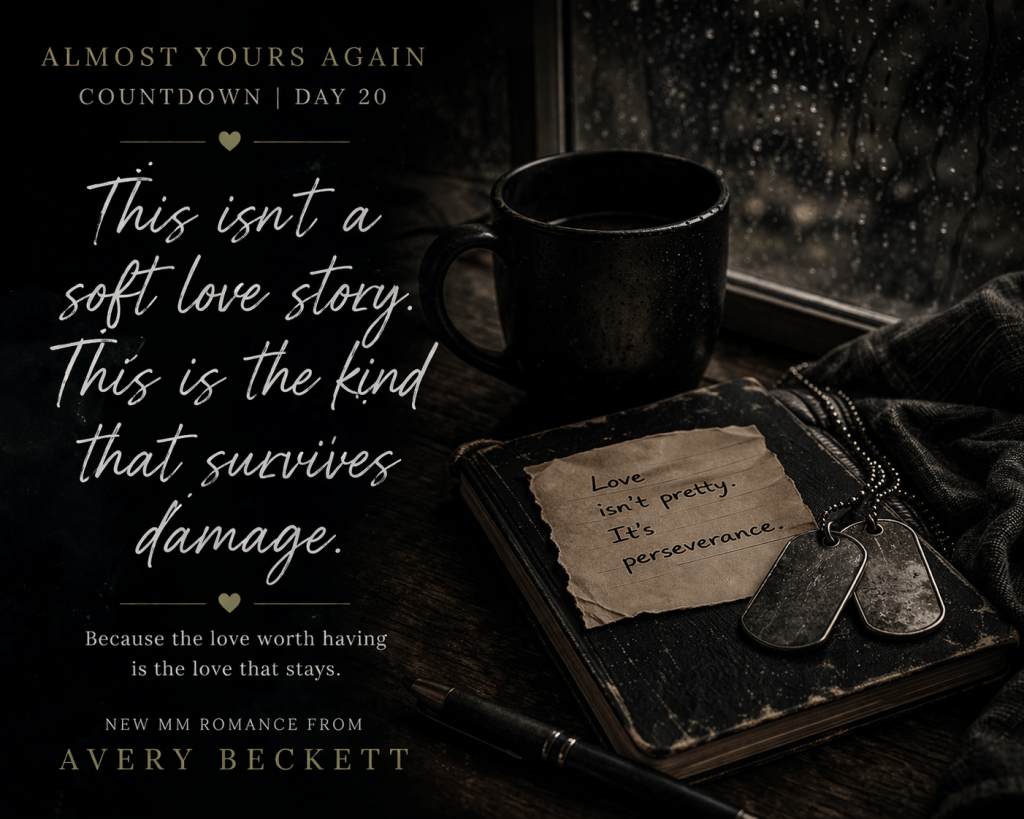
I don’t write soft love stories.
Not because I don’t believe in them. I do. There’s something genuinely lovely about a story where two people find each other before the world has had too much time to work on them — where the path is difficult but the people themselves are still, in some essential way, intact. I believe in those stories. I just don’t tend to write them.
What I’m interested in is what happens after.
After the damage. After the things that don’t leave you, even when you’ve technically moved on. After the years that change the shape of a person in ways both visible and not.
Because damage changes people. That’s not a dramatic statement — it’s just true. Physical damage. Emotional damage. The kind that comes from experience, from loss, from the accumulation of things you didn’t choose and couldn’t prevent. The kind that becomes part of your architecture whether you wanted it to or not. The version of someone before that damage isn’t the version you get later. They share a name, a history, a face — but they are not the same person, and pretending otherwise helps no one.
So the question I keep coming back to, the one that drives most of what I write, is this:
What does love look like after that?
Not before the damage. Not in spite of it. Alongside it.
In Almost Yours Again, nothing is untouched. There’s history between Marc and Finn that hasn’t been resolved neatly, because real history rarely is. There are things that were said, and things that weren’t. There are silences that calcified into something structural. There are physical realities that can’t be ignored or written around — things that happened to them, in the time between, that left marks. I wasn’t interested in minimising any of that. I wasn’t interested in a story where the damage turns out to have been smaller than it looked.
And still — there’s something there.
Not untouched. Not perfect. Not the clean, hopeful thing it might have been once, back before everything that came after. But alive. Stubbornly, inconveniently, undeniably alive.
That’s the love I’m interested in writing. The kind that has been tested by actual circumstances and not just plot mechanics. The kind that knows what the other person looks like at their worst and chooses to stay in the room. The kind that doesn’t require either person to be unbroken — just honest.
Marc and Finn are not easy people. They are not unscathed people. They are people who have been through things, separately and together, and come out the other side still recognisably themselves but fundamentally altered. Writing their love story meant taking all of that seriously — not as backstory to move past, but as the actual terrain the story moves through.
Because that’s what it is, for a lot of people.
Not a beginning. Not a clean slate. Just love, doing what love sometimes does — surviving.