We spend a lot of time thinking about who characters are at the beginning of a story.
Their strengths. Their flaws. Their habits and history. The things that define them before anything changes — before the story has had time to work on them. It’s necessary work. You can’t know where someone ends up without understanding where they started.
But I’m always more interested in who they are after.
After the moment everything shifts. After the loss, the injury, the choice they can’t take back, the version of their life they thought they were living quietly disappears. After the thing that divides everything into before and after, whether they chose that line or had it drawn for them.
Because that’s where things get real.
It’s easy to write a character when the world is more or less cooperating with their sense of themselves. It’s considerably harder — and considerably more interesting — to write who they are when that cooperation has been withdrawn. When the identity they built, the one that fit them and felt solid, no longer quite applies.
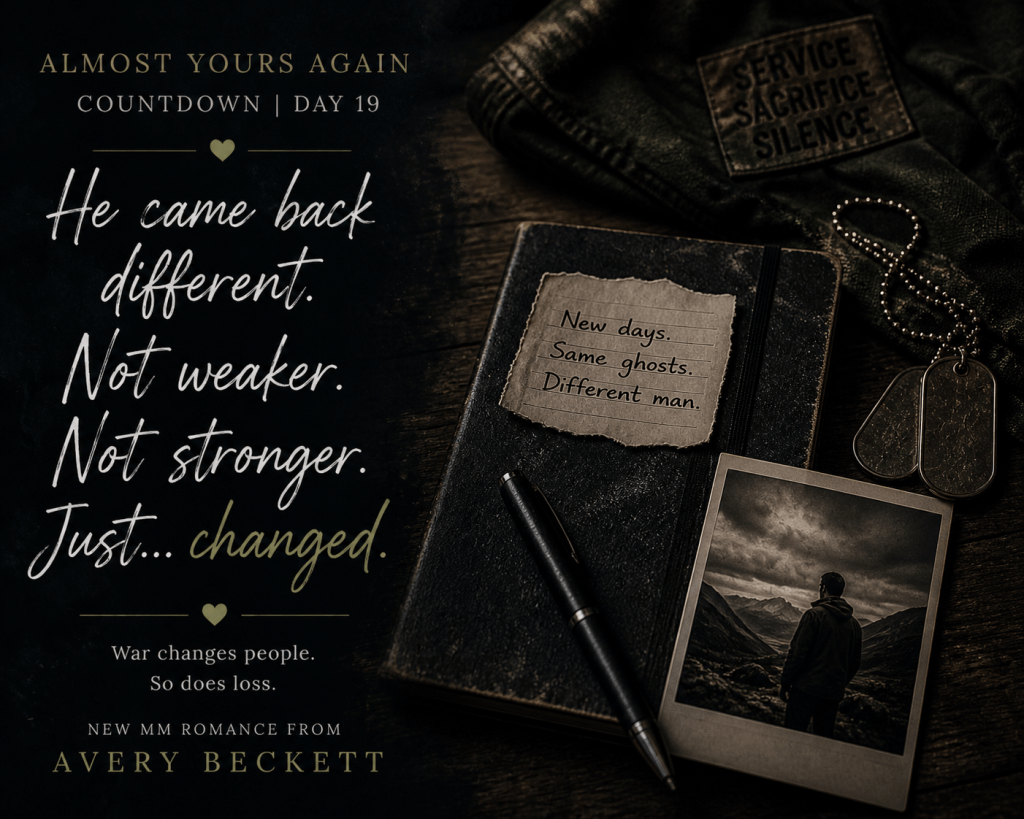
Finn isn’t the same person he was before.
I want to be careful about how I say what that means, because the shorthand is almost always wrong. It doesn’t make him weaker. It doesn’t make him stronger either, at least not in the ways people usually mean when they reach for that word — not the redemptive, forged-by-fire, better-for-it version of strength that stories often want to hand their characters as consolation. It just makes him different. And different comes with its own particular weight that isn’t quite weakness and isn’t quite strength and doesn’t fit neatly into either category.
It changes how you see yourself. How you move through the world. How you allow other people to see you — how much you let them in, how much you manage what they’re allowed to observe. The version of yourself you present, and the gap between that and what’s actually happening underneath.
Marc has to navigate that. He has to find his way to the version of Finn that exists now — not the one he remembers, not the one he carries in his chest from before, not the one he might, in his less honest moments, wish he could have back. The one who is standing in front of him. The one who has been through things Marc wasn’t there for, and carries them accordingly.
That’s not always an easy thing to do. Loving someone’s before without fully reckoning with their after is one of the quieter ways of failing someone — not out of cruelty, but out of grief for the version of them you lost. Marc is not a man given to that kind of self-indulgence, but he is a man with his own history, his own blind spots, his own particular way of needing things to make sense.
Learning to let Finn be who he is now — completely, without reservation — is part of what this story is about.
It might be the most important part.