Every book has one. The scene you circle for days before you finally sit down and face it. The scene you write and delete and rewrite, not because you can’t find the words but because the words keep costing you something.
For Almost Yours Again, it was the first one.
Not the inciting incident. Not the climax. The very first scene — Finn walking back to Marc.
I need you to understand what that costs him, because I think it’s easy to read courage and miss the layers underneath it. Finn Cooper is not, at this point in the story, a man who has much left to lose. He is broken in ways that he has stopped trying to catalogue. He is running on the particular kind of fuel that people run on when they have nothing left except one thing — one person they would burn themselves down to protect.
Flick. His sister. The person he has already sacrificed more for than anyone should ever have to sacrifice.
And he knows, with absolute clarity, that Marc will keep her safe. Regardless of everything. Regardless of how thoroughly and justifiably Marc now hates him. That is not a question in Finn’s mind — it is the one certainty he is carrying into that room. Marc Dalton is a great many complicated things, but he does not let innocent people come to harm. Finn knows this the way he knows his own heartbeat.
So Finn will fall on his sword. Willingly. He will hand Marc whatever ammunition Marc needs, accept whatever judgement is coming, make himself the price of Flick’s safety without flinching. That part, as terrifying as it is, is almost simple. It is a transaction Finn has already agreed to internally before he ever knocks on the door.
What he is not prepared for is the other thing.
Because somewhere underneath the broken pragmatism of Marc will protect her, there is something Finn has not fully let himself examine. He still loves Marc. He has never stopped. It is not something he chose or something he can undo — it is simply true, the way gravity is true, constant and unglamorous and not particularly interested in whether it’s convenient.
But here is the thing about Finn that took me a long time to fully understand, and that I think is the key to everything he is: the distance didn’t diminish it. Every month apart, every silence, every version of the life he was supposed to have that quietly closed its doors — none of it made him love Marc less. It made him love Marc more. As though loss and longing, instead of wearing the feeling down, kept deepening it. Kept adding to it. As though Finn’s love for Marc grew in the dark the way some things do — not despite the absence of light but because of it.
By the time he walks back through that door he is carrying years of that. Years of a love that just kept growing with nowhere to go.
And he does not believe it goes the other way anymore. How could it? After everything. After the choices Finn made and the damage they caused and the particular, irreversible way he disappeared from Marc’s life. Love does not survive all of that intact — or so Finn has told himself, so many times that it has become the architecture of how he moves through the world. He has accepted it. He is not walking back to Marc to reclaim anything for himself.
That is what makes it the hardest scene I’ve ever written.
Not the courage it takes to walk into that room knowing he might not walk back out the same way. Not the fear, not the brokenness, not the weight of everything riding on the next few minutes. What makes it almost unbearable to write is the quiet devastation of a man carrying a love that has only ever grown larger, walking toward the person at the centre of it, certain — absolutely certain — that what he’s bringing has nowhere left to land.
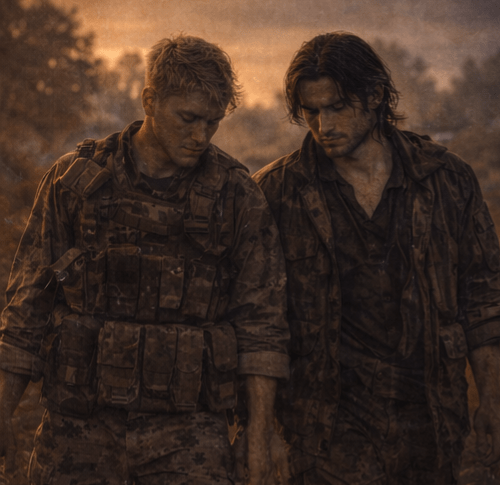
Finn is not hoping when he goes back to Marc. He has placed himself beyond hope, because hope is a luxury he can’t afford and a wound he can’t survive reopening.
He just loves him. Deeply, helplessly, more than ever.
And he’s made peace with the fact that it doesn’t matter anymore.
That is so much harder to write than anything a bullet could do to him.
And that is exactly why it had to be the first scene.
— Avery
 Avery Beckett Books