Why Broken Characters Feel The Most Human To Me

I’ve been asked before why I keep writing damaged men.

It’s a fair question. The Compass Point universe is full of them — ex-military, ex-operational, men who came home carrying things that don’t show up on any medical chart. Men who are functional on the outside and quietly fractured somewhere deeper. Men who have learned to perform okayness so convincingly that even the people who love them sometimes miss what’s underneath.

The honest answer is: because that’s what humans look like to me.

Not the polished ones. Not the ones who have it together. The ones who are doing their level best with a set of tools that got bent out of shape somewhere along the way. The ones who still show up, still try, still reach toward connection even when every instinct they have is telling them to pull back and protect themselves. Those are the characters that feel real to me. Those are the characters I can’t stop writing.

Marc and Finn felt important for a reason that’s a little difficult to articulate, which is usually a sign that it matters.

They’re not damaged in the same ways. That was the first thing that pulled me toward them — the idea that two people can be equally broken and broken entirely differently, and have to learn to navigate not just each other’s wounds but the strange places where those wounds intersect. Where one person’s damage presses directly on another person’s fracture line without either of them meaning for it to. That’s where the interesting writing lives. Not in the wound itself, but in the gap between two people who are both trying and both struggling and both — underneath all of it — desperately wanting to be known by someone.

There’s a particular kind of courage in an emotionally damaged character that I don’t think we talk about enough. It’s not the courage of the battlefield, though these men have that too. It’s the smaller, quieter, more frightening courage of choosing to try again. Of staying in a room when every trained instinct says to leave. Of saying the thing out loud when silence would be so much safer. That courage isn’t dramatic. It doesn’t make for a great action sequence. But it’s the thing that undoes me every time, as a writer and as a reader.

Marc and Finn made me work for their story in ways that felt important. They didn’t make it easy. They weren’t going to let me write around the hard parts or soften the edges or resolve things faster than they could realistically resolve. They needed me to sit in the discomfort with them, which is — I think — exactly what good romance requires. Not the avoidance of pain but the willingness to move through it, together, toward something real.

The thing about broken characters is that wholeness, when it comes, means something. It can’t be taken for granted. It was paid for in full, and the reader knows it, and the characters know it, and that earned quality of the happy ending is what separates a love story that stays with you from one that simply concludes.

I write damaged men because damage is honest. Because healing is the most hopeful thing I know how to put on a page. And because Marc Dalton and Finn Cooper reminded me, all over again, that the most human thing any of us can do is keep reaching for connection even when we’re not sure we deserve it.

They deserved it.

They always did.

— Avery
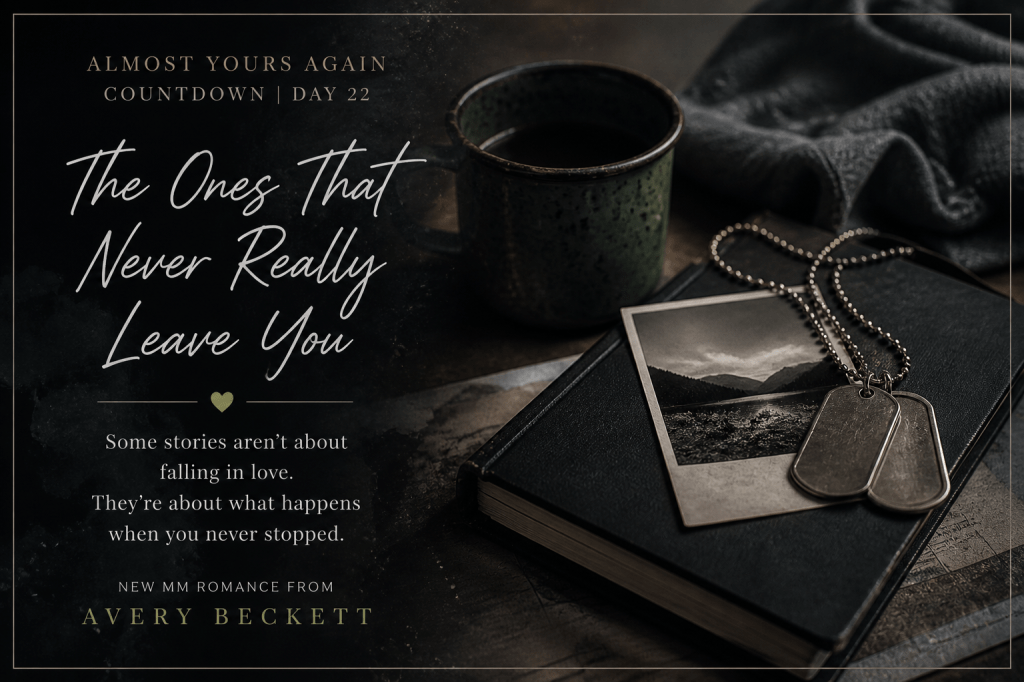
The Ones That Never Really Leave You

There are some characters who move on.

They meet someone new. They build something different. They close the door on what came before and they don’t look back. And honestly? Good for them. Clean endings are a gift. Not everyone gets one, but when a character earns it, there’s a particular satisfaction in watching them walk through that door.

And then there are the others.

The ones who don’t leave. Not really.

They might not be physically present. They might be gone for years, or a lifetime, but they linger in the quiet spaces. In the habits you don’t realise you’ve kept. In the way you reach for your phone at a particular time of day out of sheer muscle memory, months after there’s any reason to. In the way you compare every almost to something that was never quite finished.

I’ve always been drawn to those stories. I suspect you know that about me by now if you’ve spent any time in my books. My people carry things. They are, most of them, exceptionally good at functioning — at performing fine, at continuing to show up and do the work — while quietly hauling the weight of something unresolved. It’s not a flaw I write into them. It’s one of the things I find most recognisably human about them.

Not because those stories are easy. They’re not. They’re messy and complicated and often a little uncomfortable to sit inside. But they feel honest in a way that clean endings sometimes don’t. The world is full of people walking around with someone living in the back of their chest — someone they don’t talk about, someone they’ve made their peace with, mostly, except on the days they haven’t.

Almost Yours Again lives in that space.

This isn’t a story about finding someone new. It’s not a story about moving on, about choosing differently, about learning to want something safer. It’s about what happens when the person you never stopped carrying comes back into your life — not as a ghost, not as a memory, but standing right there in front of you, real and present and looking at you like time hasn’t passed at all — and suddenly everything you’ve spent years keeping carefully contained starts to shift.

Because love doesn’t always end just because time passes. Sometimes circumstances end. Distance ends. The life you’d both been planning ends. But the thing underneath — that persistent, inconvenient, impossible-to-file-away thing — doesn’t always get the memo.

Sometimes it just waits.

I spent a long time with these two. Longer than I expected. They’re not easy people — neither of them is particularly inclined to make things simple, which made writing them a genuine exercise in patience and, occasionally, exasperation. But by the time I got to the end I understood exactly why they were each other’s person, and exactly why it had taken them this long to find their way back.

I hope you’ll come with me into their story.

Almost Yours Again is available now.

I did a thing

It’s Out There. Almost Yours Again Is Actually Out There.

Tonight I uploaded Almost Yours Again to Amazon, and now I’m sitting here staring at the listing like I’m waiting for it to do something.

It won’t do anything. It’s a book listing. But here I am.

This one has been living in my head for a long time — longer than I’ll admit to — and now it belongs to anyone who wants it, which is the most exhilarating and quietly terrifying thing a writer can experience. You spend all this time with these people. You know how they think, how they argue, how they sound at two in the morning when everything is falling apart. And then you hand them over, and they’re not just yours anymore.

I think that’s the right thing. I’m about ninety percent sure that’s the right thing.

Here’s what I can tell you: this book is the beginning of something much bigger. The universe these characters live in has been mapped out to forty books. Forty. That number sounds absurd when I type it, but every single one of those stories exists for a reason — because the people in this world are complicated and layered and they don’t let go of you once you find them. Marc and Finn and the rest of the Compass Point crew have a lot of road still ahead of them.

The first ten books are written and edited and ready. One a month for the next ten months. Whether that plan makes me dedicated or slightly unhinged is genuinely up for debate, and I’m choosing not to examine it too closely right now.

Right now I just want to sit with the fact that Almost Yours Again is real. It’s listed. Someone out there who needs this story can find it.

That’s not nothing.

That’s actually everything.

If you pick it up — thank you. If you love it, tell someone. If you want to know what comes next, stay close. There is so much more coming.

It’s Getting Very Real (And I’m Not Okay — In the Best Possible Way)

I’ve been trying to write this post for three weeks.

Every time I sit down to do it, I stare at the screen for a while, type something, delete it, and go make another cup of tea. My friend Karen, who has heard more about this book and these characters than any person should reasonably have to endure, has been very patient. She has also been very gently suggesting, in the way she does, that perhaps I should just write the thing, Avery.

So. I’m writing the thing.

Almost Yours Again is at the editor. The cover has been made. The cover reveal is locked in for May 20th. And the book goes live on June 1st.

June 1st. Thirty-four days from today.

I need you to understand something about what it means to type that sentence.

I have been living inside the Compass Point Security universe for fifteen years. Alone, mostly, in the way that writing is always fundamentally alone — just me and the characters and the particular madness of a world that refused to stop expanding every time I turned my back on it. Forty books across four series. The novellas that exist because certain characters were absolutely not going to accept a supporting role and I don’t know why I ever thought they would. Fifteen years of notes and scenes and timelines and character voices that have become so familiar I sometimes forget they don’t actually exist.

Karen has been alongside me for a lot of that. Not writing Avery — that’s mine, entirely mine, my voice and my world and my particular obsession — but there. The person on the other end of the phone when I couldn’t work something out. The one who has heard about Marc and Finn probably more than she ever asked to, and who kept listening anyway. We work together on other projects, Karen and I, and that partnership has taught me what it means to have someone who truly understands what you’re trying to do — which makes her support of this work, the work that’s entirely my own, mean more than I can easily say.

But Almost Yours Again is mine. That matters to me and I want to say it clearly, because this is the work I built alone across fifteen years and a great deal of very strong tea.

Marc and Finn are the heart of everything in this universe. That’s not hyperbole — it’s architecture. Every series, every character, every thread that runs through Compass Point traces back to them. They are the reason the world exists in the form it does. And Almost Yours Again is their story: the one I’ve been holding the longest, the one I’ve circled back to again and again over fifteen years of building everything else around it. The one that had to come first, even though — especially because — it’s the most important one.

For those of you who are new here: Marc Dalton and Finn Cooper are the soul of Compass Point Security. Everything else in this universe grows from what they are to each other, what they’ve been through, and what it costs two people to find their way back when the distance between them has been measured in years and silence and choices that couldn’t be unmade. That’s all I’m going to say right now. The book will say the rest.

For those of you who have been waiting — who have been here through the years of it’s coming, I promise it’s coming — I don’t have adequate words for what it means to finally be writing it’s here. Or almost here. Close enough that I can see it from where I’m standing and it doesn’t disappear when I blink.

The manuscript is with the editor, which means it’s temporarily out of my hands and in capable ones. The cover exists and is beautiful and I am being heroically restrained about not sharing it before the 20th. Fifteen years of waiting has given me a certain capacity for delayed gratification. I am drawing on every last bit of it.

Here is what I know about June 1st: it’s the day forty books get their foundation. Everything I have built in this universe — every team, every mission, every love story, every scar and every choice and every moment of two people deciding each other is worth the risk — gets its why on that day. Marc and Finn are the answer to questions the rest of the series is still asking. That’s what it means to have lived in a world this long. You know, eventually, where everything comes from.

This is where it comes from.

Fifteen years. One universe. The cover reveal is May 20th. The book is June 1st.

Almost there. Almost yours.

— Avery


Almost Yours Again is Book 1 of the Compass Point Security universe — the beginning of forty books across four series. Cover reveal: May 20th. Publication: June 1st. Sign up to the newsletter to be the first to see it.

Why Some Characters Don’t Believe They Need Love

There’s a particular kind of character who walks into a story already convinced of one thing:

They are not the person who gets to be loved.

Not because they’re cruel.
Not because they’re incapable of it.

But because somewhere along the way they decided love wasn’t meant for them.

In the Avery Beckett universe, many of those characters are soldiers.

And soldiers learn very early that survival changes the way you see yourself.


Survival Guilt Changes the Equation

Soldiers carry a quiet mathematics in their heads.

Who came home.
Who didn’t.
Who should have.

Sometimes the answers to those questions don’t make sense.

Sometimes the person who lived was the one who believes they deserved it the least.

Survival guilt doesn’t always look dramatic. Often it’s quiet. A background noise that says: You’re still here, and they’re not.

Over time, that thought becomes something else.

A belief.

That the life you’re living now isn’t something you get to fill with joy.
That your job is simply to carry forward.

To finish the work.

To protect the people who remain.

Love starts to feel like something that belongs to other people.

People who didn’t walk away from the same battlefield.


Protectors Don’t Expect Protection

Another truth soldiers absorb is that their role in the world is very clear.

They are the ones who stand between danger and everyone else.

They are the shield.

When someone spends years living that way, the idea of being protected themselves starts to feel… wrong.

Unnatural.

They’re comfortable being the one who takes the hit.
The one who stays standing.
The one who makes sure everyone else makes it out.

But when someone tries to stand between them and the danger?

That’s harder to accept.

Because it disrupts the role they’ve built their identity around.

They believe they’re the protectors.

Not the protected.


Emotional Restraint Is a Survival Skill

For soldiers, emotional restraint isn’t just personality.

It’s training.

In high-risk environments, emotions can cloud judgement. Fear can slow you down. Grief can distract you when someone else’s life depends on your focus.

So they learn to compartmentalize.

They learn to set feelings aside until the mission is over.

The problem is that habit doesn’t disappear when the war ends.

It follows them home.

They become quiet about their pain. Careful with their emotions. Slow to trust anything that might destabilize the control they worked so hard to build.

And love—real love—is destabilizing.

It asks for vulnerability.

For openness.

For the kind of emotional exposure they’ve spent years learning how to avoid.


Touch Has to Be Earned

For some characters, touch is easy.

For soldiers who have lived with trauma, it often isn’t.

Physical closeness means trust. It means letting someone close enough to see what’s underneath the armor.

In many Avery Beckett stories, touch isn’t casual.

It’s earned.

The first hand on a shoulder.
The first quiet moment sitting beside someone without tension.
The first time a character realizes they didn’t instinctively pull away.

These moments matter because they signal something deeper.

Safety.

Not the absence of danger.

But the presence of someone who makes the world feel survivable again.


Love Feels Like a Risk They Can’t Justify

If you already believe your job is to protect others, love starts to look like a liability.

Because loving someone gives the world something to take from you.

It creates vulnerability.

It introduces the possibility of loss.

And for someone who has already lost too much, the instinct is simple:

Better not to start.

Better to stay alone.

Better to keep your focus on the mission.


Why They’re Wrong

The truth, of course, is that none of this means they don’t deserve love.

It means they’ve spent so long protecting others that they’ve forgotten they’re human too.

They forget that safety doesn’t only come from being strong.

Sometimes it comes from letting someone else hold the line for a while.

From letting someone see the parts of you that aren’t invincible.

From discovering that protection can go both ways.


The Quiet Power of Being Chosen

The most powerful moments in stories like these aren’t the dramatic declarations.

They’re the quiet realizations.

The moment a character understands that someone stayed.

That someone chose them.

Not because they were perfect.
Not because they were unbroken.

But because they were worth loving anyway.

And for someone who spent years believing love was for other people, that realization can change everything.

Because sometimes the bravest thing a protector can do…

is finally let themselves be protected.