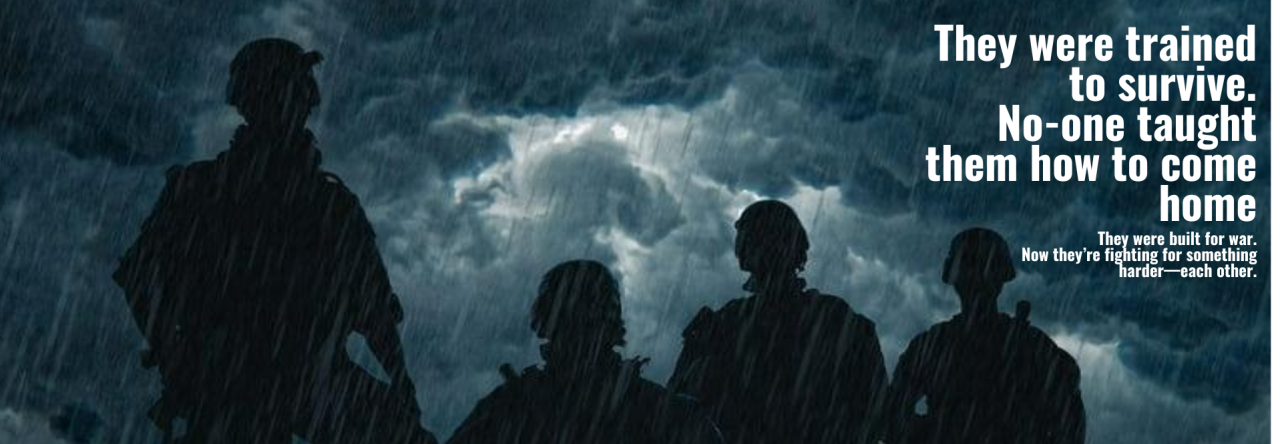
I could talk about the plot. I could tell you about the love story, about Marc and Finn and the long road back to each other, about what it costs and what it gives back. That story matters to me enormously and I hope it matters to you too.
But that’s not what I most hope you carry with you when you close the final page.
What I hope you take away is this: a little more understanding. A little more patience. A little more willingness to look at someone who seems fine, who looks fine, who is functioning and present and getting through their days — and understand that fine is sometimes the bravest thing a person can manage.
We send our people to war. We send them into environments where every sense is weaponised against survival — where a sound means incoming, where a shadow means danger, where the body learns, because it has to learn, to treat the world as a place that is trying to kill you. The nervous system does not know it’s fictional. It cannot distinguish between a training environment and a combat zone, not after long enough, not after enough repetition. It simply learns. It adapts. It rewires itself around the information it has been given, which is: this is what threat sounds like. This is what danger feels like. This is what you do to survive.
And then we bring them home.
We bring them home and we expect the rewiring to reverse itself. We expect them to sit at a backyard barbecue while balloons pop around them and not flinch. We expect them to hear a helicopter overhead and think nothing of it. We expect sirens to be background noise rather than the thing their entire nervous system still insists, at a level below conscious thought, means something is very wrong.
They cannot always do that. Not because they are weak. Not because they haven’t tried. But because the body remembers what the mind is trying to move past, and the body is not interested in being reasoned with.
Finn Cooper knows this. He lives inside it. And what I wanted to write — what I tried, with everything I had, to get right — is not the dramatic version of that struggle but the daily version. The private, exhausting, unglamorous reality of carrying something that most people around you cannot see and would not understand if they could.
I hope that when you finish this book and you encounter someone in your life who struggles with loud noises, with crowds, with unpredictability, with the ordinary chaos of a world that doesn’t know it’s supposed to be safe now — I hope you think of Finn. I hope you extend the grace that Finn deserves and doesn’t always receive. I hope you understand, even a little more than you did before, that what looks like overreaction from the outside is often survival from the inside.
Our veterans gave something that cannot be fully given back. The least we can offer in return is understanding.
That is what I hope you take away.
That, and the love story. Always the love story.
— Avery
 Avery Beckett Books