Why Found Family Will Always Matter To Me

Some people are never meant to be parents.

I think most of us know at least one. The evidence is written in the people they raised — in the particular shape of the damage, in the things that were missing, in the ways a child learned to be small or quiet or self-sufficient far earlier than any child should have to be. We don’t talk about it easily, because we’re taught that family is sacred and that love is automatic and that blood means something fundamental.

But sometimes blood just means someone shares your DNA. And sometimes that person had no business being entrusted with a child.

My own life taught me this. My characters confirmed it.

Finn Cooper’s father sold his young daughter for drugs.

I need you to sit with that sentence for a moment. Not move past it. Sit with what it means — a man who looked at his child and saw something exchangeable. Something with a transaction value. A man who made the most profound betrayal a parent can make, casually, in service of his own need, and left his children to navigate the wreckage of it.

Finn couldn’t live with that. Not because he was required to fix it, not because anyone appointed him protector, but because he looked at his sister and made a choice. The choice that actual family makes. He would keep her safe. Whatever that cost. He stopped eating so the money he would have spent on food could go to her instead. He carried her safety like a second skeleton, beneath everything else he carried, and he didn’t put it down.

That is not obligation. That is love in its most active and costly form. The kind that doesn’t wait to be asked.

And then there is the image I will never be able to shake, the one that lives at the intersection of everything I believe about chosen family and what it makes people capable of.

Finn Cooper, with a fractured skull, dragging the man he loved thirty metres.

Thirty metres. With a fractured skull. Because Marc was his — his person, his found family, the love he had nearly erased himself to protect — and Finn Cooper was not going to let his found family fracture. Not while he had any capacity left to prevent it. Not while he could still move. Not while there was any version of himself still functioning that could get between Marc and the worst possible outcome.

That’s the thing about found family. It’s not softer than blood. It is frequently harder, fiercer, more deliberately held. Because you chose it. Because you looked at these people and decided — consciously, with full knowledge of the cost — that they are yours and you are theirs and you will not let go. Blood family is assigned. Found family is earned, on both sides, and the choice to keep earning it is renewed every day.

Finn earned it. With everything he had. With his hunger and his silence and his self-erasure and ultimately, when it came to it, with his body and his fractured skull and thirty metres of sheer unwillingness to let the people he loved be taken from him.

I wrote that and I wept.

I wrote it because I know something about families that shouldn’t have been, and about the people who come after and decide to build something better from the rubble. About the way humans reach toward each other in the absence of what they should have had and create, against all odds, something real and warm and worth protecting.

Found family is never a consolation prize. For many of us, it is the whole prize. The only one that ever felt true.

Finn Cooper understood that in his bones.

So do I.

— Avery

The Characters Who Stayed With Me After Writing

Every writer has them.

The characters you didn’t plan to love as much as you did. The ones who were supposed to occupy the edges of the story and instead walked to the centre of it and refused to leave. The ones who are still with you long after the manuscript is finished, still talking, still surprising you, still doing things in the back of your mind that haven’t made it onto the page yet.

The Compass Point universe is full of them. But four in particular have stayed with me in ways I didn’t entirely anticipate when I started writing, and I want to talk about why.

Fallon.

Flick. The girl with the band and the music and the particular quality of aliveness that made everyone in every room turn toward her without quite knowing why. She almost ran away with the series entirely, and there were days I would have let her.

The love story at the heart of her book is a complicated one, and deliberately so. Darius is almost twice her age. He met her when she was sixteen, and what he felt in that moment was immediate and absolute and completely impossible — and he knew it. So he did what an honourable man does when he feels something he has no right to feel. He removed himself. He took himself away from her and built walls and made himself scarce and tried, with every tool available to him, to do the right thing.

But Fallon is a particular kind of girl. The kind that stays with you regardless of distance. The kind that rewrites the internal landscape of everyone who loves her without even trying. And when she was nineteen and her life was in danger, Darius drove through the night without a second thought — because he simply didn’t have a choice. He never really had a choice. That’s the truth about loving someone like Fallon. The choice gets made for you.

Writing that — the intersection of honour and helplessness, the years of doing the right thing finally meeting the moment where the right thing and the necessary thing are exactly the same — was some of the most satisfying work I’ve done.

Knox and Garrett.

These two. These two.

Ten years. They had loved each other for ten years and been too terrified to say it. Not because they didn’t know — they knew, I think they always knew — but because some things are so important that the risk of losing them by speaking feels greater than the pain of keeping silent. And so they kept silent. For ten years they were whatever they were to each other, and they kept it locked down behind duty and professionalism and the particular stubbornness of two men who have survived everything the world threw at them and learned, perhaps too well, to keep their own counsel.

Knox’s hearing is failing. He carries that privately, in the way he carries everything — with a competence and a steadiness that doesn’t invite discussion. Garrett’s nights are something else entirely. PTSD doesn’t leave much room for softness, and Garrett has spent years in the dark hours fighting a private war that the daylight never fully sees.

What breaks them open, finally, is not a grand romantic gesture. It’s the thing it always is with men like these — necessity. Crisis. The moment when life is on the line and the things you’ve been too careful to say become the only things that matter. They do the right thing, as Knox and Garrett always do, and it nearly costs them everything, and in the aftermath of that there is simply no road left that leads back to pretending.

Ten years of love finally given a name. The weight of that — the relief and the grief and the fury at all the time and all the silence — was something I felt all the way through writing it.

Marc and Finn are my truest babies. That will never change. They live in a particular chamber of my writer’s heart that is entirely their own.

But Fallon, and Darius, and Knox, and Garrett?

They are right there with them. Right there.

And I suspect they always will be.

— Avery

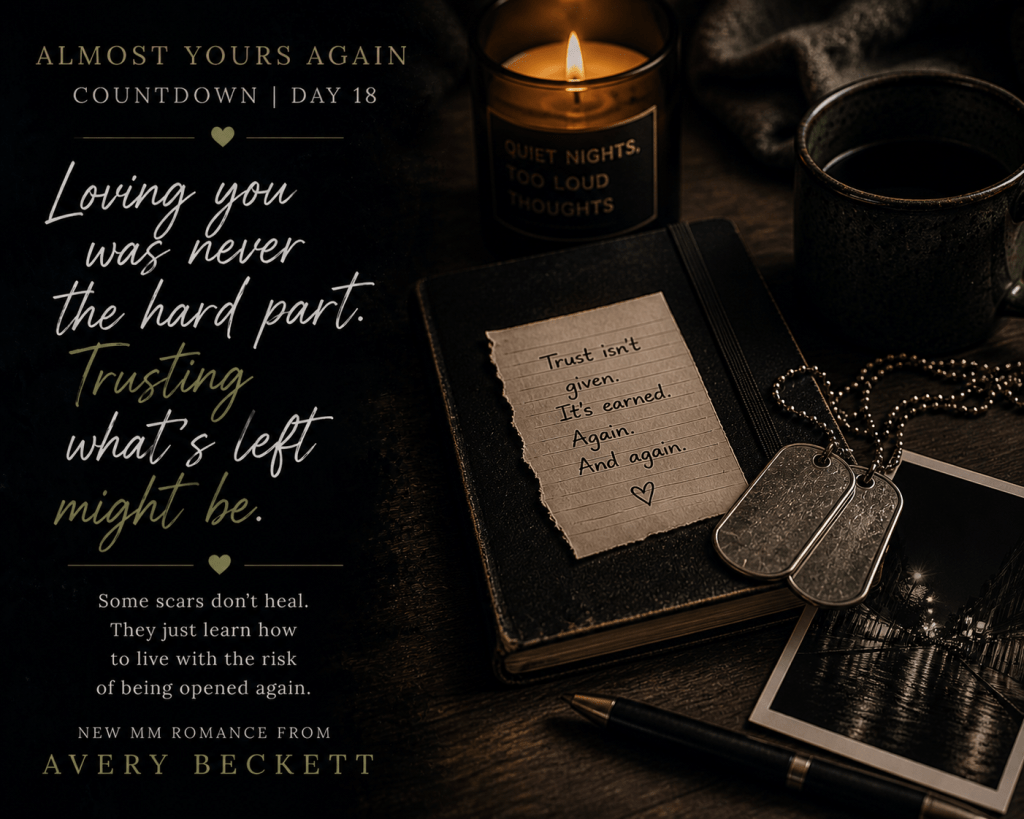
Building The Emotional Core Of Almost Yours Again

Some books are held together by plot.

Things happen. Stakes escalate. External forces push the characters toward each other or pull them apart, and the momentum of events carries the story forward. That architecture works. It works well. I’ve written it and I’ll write it again.

Almost Yours Again is not that book.

This one was always going to be different, and I knew it early. Because the question at the centre of this story wasn’t what happens next — it was can they find their way back to each other, and those are fundamentally different engines. One runs on event. The other runs on feeling. And feeling is both harder to write and, when it works, infinitely more devastating to read.

The challenge with emotional rebuilding as a story foundation is that you can’t fake it. You can fake action. You can construct a plot event that forces two characters into proximity and call it tension. But you cannot construct your way to the moment where two people who have hurt each other — or lost each other, or let each other go for reasons that made sense at the time — genuinely begin to trust again. That has to be earned. Every single step of it has to be paid for in full, on the page, in real time, and the reader has to feel every payment.

That’s what Almost Yours Again demanded from me.

These are two people who know each other. That’s the thing about second chance romance that makes it both richer and harder than a first meeting — the knowing. They don’t have the luxury of a fresh start. They come to each other carrying history, carrying the specific weight of what was and what went wrong and what they each have thought about in the quiet hours when they couldn’t stop themselves. There is no discovering each other here. There is only the much more complicated business of re-learning someone you thought you already knew, and finding that they are both exactly who you remembered and entirely someone new.

I had to build the emotional architecture carefully. Every conversation carries more freight than it would between strangers, because these characters know what certain words have meant before. A particular phrase lands differently when you’ve heard it said in a different context, years ago, under different circumstances. Silence between them is textured in ways that silence between new lovers simply isn’t. I had to hold all of that history without letting it overwhelm the present — to let it inform every scene without allowing it to become the whole story.

What holds Almost Yours Again together is not what happens. It’s the gradual, fragile, tentative process of two people deciding — again, and with full knowledge of the risk — that the other one is worth it. That decision doesn’t happen in a single moment. It happens in increments. In small gestures noticed and remembered. In the moment someone chooses honesty when a deflection would have been easier. In the moment someone stays in the room when every instinct says to leave. In the accumulated weight of tiny choices that, taken together, build something solid enough to stand on.

That’s what I was writing. Not the plot that surrounds it — though there is one, and it matters — but the interior life of two people learning to be brave enough to want something they’ve already lost once.

There’s a particular kind of intimacy in second chance stories that I find endlessly compelling. These characters have seen each other at their least composed. They know the specific shape of each other’s flaws. They cannot present a best self because the other person has already seen the rest of it. And somehow — despite all of that, or perhaps because of it — they are choosing again. With open eyes. With no illusions.

That strikes me as one of the most genuinely romantic things a person can do.

Almost Yours Again was always going to be a quiet book, in the way that the most emotionally intense things are often quiet. It doesn’t announce itself. It doesn’t escalate loudly. It just does the slow, careful, necessary work of showing two people rebuilding something that matters, one honest moment at a time.

I hope it feels like that when you read it.

I hope it feels true.

— Avery

The Difference Between Trauma and Weakness

Let me be clear about something from the start.

Trauma is not weakness. It has never been weakness. It is what happens to a person when they have been through something that would break most people, and they came out the other side still standing — changed, carrying it, sometimes staggering under the weight of it, but standing. That is not weakness. That is the opposite of weakness. And every character in the Compass Point universe made sure I never forgot it.

This distinction matters to me more than almost anything else I do on the page.

But I want to talk about Finn Cooper specifically. Because if there is one character in this universe who could be looked at from the outside and have the word weak applied to him, it’s Finn. And I want to explain exactly why that reading is not just wrong, but is in fact the complete inverse of the truth.

Finn was fading. That’s the honest way to describe it. He was making himself smaller, quieter, less present. He stopped eating. He drifted out of Marc’s life. He withdrew from the people who cared about him in ways that looked, if you weren’t paying close attention, like a man giving up.

He wasn’t giving up.

He was starving himself so the money he would have spent on food could go to keeping his baby sister safe. Let that sit for a moment. Not skipping a meal. Not tightening his belt. Choosing, deliberately and repeatedly, not to eat — because someone he loved needed what that money could do more than he needed to be fed. That is not the action of a weak man. That is a love so large and so selfless it consumed him from the inside out, and he let it, because the alternative was her being unprotected and that was simply not something Finn Cooper was capable of allowing.

And Marc. He drifted from Marc not because he didn’t love him — the love was never the question — but because he could feel himself becoming a burden and he loved Marc too much to be one. He was shrinking himself deliberately, removing himself from the equation, making the calculation that the people in his life would be better off with less of him in it. Not because he didn’t value himself enough. But because he valued them so much that their comfort outweighed his own survival instinct.

That is not weakness.

That is a depth of love that most people will never be capable of. The willingness to disappear for someone else’s sake. The willingness to be hungry, to be alone, to be fading — and to do it quietly, without asking for recognition, without making it anyone else’s problem. Finn wasn’t collapsing. He was choosing. Over and over, every day, in the most painful possible direction, he was choosing the people he loved over himself.

What looks like surrender is, on examination, one of the most sustained acts of courage I have ever written.

That’s the thing about trauma. It doesn’t always announce itself loudly. Sometimes it looks like a man getting quieter. Sometimes it looks like absence, like withdrawal, like someone making themselves easy to overlook. And from the outside it can be mistaken for weakness, for passivity, for someone who has stopped fighting.

But Finn was fighting the whole time. He was just fighting for everyone except himself.

The rest of the Compass Point people carry their damage differently. Wyatt, walking the line between who he was and who he might have to become, doing it with the same bone-deep steadiness he brings to everything. Knox and Garrett, building a family out of the rubble of operational lives, holding it together every day because three kids needed them to. Every couple in this universe carrying something, and none of them — not once — giving me weakness.

What they give me instead is the full complexity of people who are strong and struggling simultaneously. Who can be capable and in pain at the same time. Who need things desperately and have no language for asking. Who are, even at their most diminished, still themselves in the deepest and most unshakeable sense.

Finn Cooper nearly disappeared trying to love people properly.

That’s not weakness.

That’s the bravest thing I know.

— Avery

Why Broken Characters Feel The Most Human To Me

I’ve been asked before why I keep writing damaged men.

It’s a fair question. The Compass Point universe is full of them — ex-military, ex-operational, men who came home carrying things that don’t show up on any medical chart. Men who are functional on the outside and quietly fractured somewhere deeper. Men who have learned to perform okayness so convincingly that even the people who love them sometimes miss what’s underneath.

The honest answer is: because that’s what humans look like to me.

Not the polished ones. Not the ones who have it together. The ones who are doing their level best with a set of tools that got bent out of shape somewhere along the way. The ones who still show up, still try, still reach toward connection even when every instinct they have is telling them to pull back and protect themselves. Those are the characters that feel real to me. Those are the characters I can’t stop writing.

Marc and Finn felt important for a reason that’s a little difficult to articulate, which is usually a sign that it matters.

They’re not damaged in the same ways. That was the first thing that pulled me toward them — the idea that two people can be equally broken and broken entirely differently, and have to learn to navigate not just each other’s wounds but the strange places where those wounds intersect. Where one person’s damage presses directly on another person’s fracture line without either of them meaning for it to. That’s where the interesting writing lives. Not in the wound itself, but in the gap between two people who are both trying and both struggling and both — underneath all of it — desperately wanting to be known by someone.

There’s a particular kind of courage in an emotionally damaged character that I don’t think we talk about enough. It’s not the courage of the battlefield, though these men have that too. It’s the smaller, quieter, more frightening courage of choosing to try again. Of staying in a room when every trained instinct says to leave. Of saying the thing out loud when silence would be so much safer. That courage isn’t dramatic. It doesn’t make for a great action sequence. But it’s the thing that undoes me every time, as a writer and as a reader.

Marc and Finn made me work for their story in ways that felt important. They didn’t make it easy. They weren’t going to let me write around the hard parts or soften the edges or resolve things faster than they could realistically resolve. They needed me to sit in the discomfort with them, which is — I think — exactly what good romance requires. Not the avoidance of pain but the willingness to move through it, together, toward something real.

The thing about broken characters is that wholeness, when it comes, means something. It can’t be taken for granted. It was paid for in full, and the reader knows it, and the characters know it, and that earned quality of the happy ending is what separates a love story that stays with you from one that simply concludes.

I write damaged men because damage is honest. Because healing is the most hopeful thing I know how to put on a page. And because Marc Dalton and Finn Cooper reminded me, all over again, that the most human thing any of us can do is keep reaching for connection even when we’re not sure we deserve it.

They deserved it.

They always did.

— Avery

Memory Doesn’t Fade the Way You Think

There’s a comfortable assumption about time.

That it softens things. That distance does its work gradually and reliably — that what felt sharp and immediate in the living of it eventually becomes something easier to carry. Something worn smooth by years of handling. Something you can set down when you need to and pick back up without it cutting you.

Sometimes that’s true.

But not always.

Some memories don’t fade. They don’t blur at the edges or lose their colour or compress into a generalised feeling that’s easier to manage than the specific thing itself. They settle. They shift slightly, maybe — the way anything does when it’s lived with long enough — but they don’t lose their clarity. If anything they become more defined over time. More precise. The irrelevant details fall away and what’s left is exactly what mattered. Not just what happened, but how it felt. What it cost. What it meant in the moment and what it continued to mean long after the moment was gone.

Marc remembers.

Not in the vague, softened way that would make this simpler. Not in the way that would allow him the mercy of uncertainty — of not being quite sure, after all this time, whether what he remembers is accurate or whether the years have reshaped it into something more than it was. He doesn’t have that. What he has is something detailed and specific and stubbornly intact, something that has sat quietly in him through everything that came after, maintaining its weight with no apparent interest in diminishing.

That’s part of why this isn’t simple.

He’s not working with an impression of the past. He’s working with the past itself — precise and present and fully capable of making itself felt.

And when that kind of memory meets the reality of the present again, it doesn’t stay quiet and cooperative in the corner where it’s been kept. It surfaces. It insists. It lays itself alongside what’s actually happening and demands to be part of the reckoning.

Memory like that doesn’t ask for attention.

It takes it.

Almost Yours Again

Second Chances Aren’t Clean

There’s a particular idea about second chances that turns up everywhere — in stories, in advice columns, in the things well-meaning people say when they’re trying to be encouraging.

The idea that second chances are hopeful. That they arrive carrying a sense of renewal, a lightness, a door opening onto something that looks and feels like a fresh start. A chance to do things differently, the thinking goes, without the weight of the past pressing in. You know more now. You’re wiser. You get to begin again.

I don’t think that’s how it works.

Second chances aren’t clean. They never are. They come with history and memory and the particular, uncomfortable awareness of exactly how things can go wrong — because you’ve already lived it once. You know the specific shape of that failure. You know which moments were the turning points, which decisions made things worse, which words landed wrong and which silences grew into something structural. You carry all of that into the second chance whether you want to or not.

There’s no pretending it didn’t happen.

No resetting to the beginning. No standing at the start of something with the honest innocence of people who don’t yet know what they’re capable of doing to each other.

Marc and Finn don’t get a fresh start. What they get is a continuation. A return. A moment where everything that was left unresolved — everything that was packed away and managed and quietly carried through the years — is suddenly right there again, present and immediate and asking, with some urgency, to be dealt with.

And that’s harder than starting over. Genuinely harder. Starting over is its own kind of painful, but it has the mercy of the unknown. You don’t know yet what you’re building or how it might fail. There’s room for hope that hasn’t been tested.

Rebuilding doesn’t have that mercy.

When you’re rebuilding, you’re working with the original materials — the history, the feeling, the connection that survived everything it was put through — and trying to construct something that can hold more weight than it did before. You have to look clearly at why it didn’t hold the first time. You have to decide which parts are still sound and which need to be replaced entirely. You have to do all of that while standing next to the person who was there for the original collapse.

That takes a particular kind of courage that doesn’t get talked about enough.

Not the courage of beginning. The courage of returning.

When Seeing Them Again Isn’t Soft

Reunions are often written as gentle things.

A moment of recognition across a room. The gradual realisation. Relief washing in slowly, softening everything. Two people finding their way back to each other in a scene that gives the reader time to breathe, time to feel it, time to settle into what’s happening alongside the characters.

There’s a reason that version exists. It’s earned. It’s earned when the story has built toward it carefully, when the distance has been long enough that arriving somewhere is its own kind of peace.

But not all reunions feel like that.

Some feel like impact.

Like everything you’ve been holding carefully in place — the distance you’ve maintained, the equilibrium you’ve constructed, the version of yourself that has learned to function without this person in it — shifts all at once. Without warning. Without the courtesy of a gradual approach. Like your body reacts before your mind has had any chance to catch up, before the part of you that makes considered decisions has even registered what’s happening.

Like there is no distance at all between what you feel and the moment itself.

That’s what this reunion is.

It’s not calm. It’s not measured. There’s no slow unfolding, no careful navigation of what this means or how to handle it. It’s immediate in the way that some things are just immediate — not because Marc and Finn are people who lose control easily, because they’re not, but because some things bypass the systems you’ve built to manage them.

Because when someone has that kind of history with you, seeing them again doesn’t come with a buffer. There’s no gradual adjustment period, no gentle recalibration. The body remembers what the mind has spent years trying to organise into something manageable.

It just hits.

And then you’re standing there, in the middle of whatever ordinary moment this interrupted, with all of it suddenly present and immediate and completely uninterested in your carefully maintained equilibrium.

And then you have to decide what to do with that.

That moment — the one right after impact, when the dust is still moving and nothing has been said yet and everything is possible and terrible simultaneously — is one of my favourite things to write. Not the reunion itself. What comes immediately after it. The split second where a character has to choose, consciously or not, who they’re going to be in response to something they weren’t prepared for.

Marc makes a choice in that moment.

Whether it’s the right one is something you’ll have to decide for yourself.

Almost Yours Again

Who You Are After Everything Falls Apart

We spend a lot of time thinking about who characters are at the beginning of a story.

Their strengths. Their flaws. Their habits and history. The things that define them before anything changes — before the story has had time to work on them. It’s necessary work. You can’t know where someone ends up without understanding where they started.

But I’m always more interested in who they are after.

After the moment everything shifts. After the loss, the injury, the choice they can’t take back, the version of their life they thought they were living quietly disappears. After the thing that divides everything into before and after, whether they chose that line or had it drawn for them.

Because that’s where things get real.

It’s easy to write a character when the world is more or less cooperating with their sense of themselves. It’s considerably harder — and considerably more interesting — to write who they are when that cooperation has been withdrawn. When the identity they built, the one that fit them and felt solid, no longer quite applies.

Finn isn’t the same person he was before.

I want to be careful about how I say what that means, because the shorthand is almost always wrong. It doesn’t make him weaker. It doesn’t make him stronger either, at least not in the ways people usually mean when they reach for that word — not the redemptive, forged-by-fire, better-for-it version of strength that stories often want to hand their characters as consolation. It just makes him different. And different comes with its own particular weight that isn’t quite weakness and isn’t quite strength and doesn’t fit neatly into either category.

It changes how you see yourself. How you move through the world. How you allow other people to see you — how much you let them in, how much you manage what they’re allowed to observe. The version of yourself you present, and the gap between that and what’s actually happening underneath.

Marc has to navigate that. He has to find his way to the version of Finn that exists now — not the one he remembers, not the one he carries in his chest from before, not the one he might, in his less honest moments, wish he could have back. The one who is standing in front of him. The one who has been through things Marc wasn’t there for, and carries them accordingly.

That’s not always an easy thing to do. Loving someone’s before without fully reckoning with their after is one of the quieter ways of failing someone — not out of cruelty, but out of grief for the version of them you lost. Marc is not a man given to that kind of self-indulgence, but he is a man with his own history, his own blind spots, his own particular way of needing things to make sense.

Learning to let Finn be who he is now — completely, without reservation — is part of what this story is about.

It might be the most important part.

Love That Survives Damage

I don’t write soft love stories.

Not because I don’t believe in them. I do. There’s something genuinely lovely about a story where two people find each other before the world has had too much time to work on them — where the path is difficult but the people themselves are still, in some essential way, intact. I believe in those stories. I just don’t tend to write them.

What I’m interested in is what happens after.

After the damage. After the things that don’t leave you, even when you’ve technically moved on. After the years that change the shape of a person in ways both visible and not.

Because damage changes people. That’s not a dramatic statement — it’s just true. Physical damage. Emotional damage. The kind that comes from experience, from loss, from the accumulation of things you didn’t choose and couldn’t prevent. The kind that becomes part of your architecture whether you wanted it to or not. The version of someone before that damage isn’t the version you get later. They share a name, a history, a face — but they are not the same person, and pretending otherwise helps no one.

So the question I keep coming back to, the one that drives most of what I write, is this:

What does love look like after that?

Not before the damage. Not in spite of it. Alongside it.

In Almost Yours Again, nothing is untouched. There’s history between Marc and Finn that hasn’t been resolved neatly, because real history rarely is. There are things that were said, and things that weren’t. There are silences that calcified into something structural. There are physical realities that can’t be ignored or written around — things that happened to them, in the time between, that left marks. I wasn’t interested in minimising any of that. I wasn’t interested in a story where the damage turns out to have been smaller than it looked.

And still — there’s something there.

Not untouched. Not perfect. Not the clean, hopeful thing it might have been once, back before everything that came after. But alive. Stubbornly, inconveniently, undeniably alive.

That’s the love I’m interested in writing. The kind that has been tested by actual circumstances and not just plot mechanics. The kind that knows what the other person looks like at their worst and chooses to stay in the room. The kind that doesn’t require either person to be unbroken — just honest.

Marc and Finn are not easy people. They are not unscathed people. They are people who have been through things, separately and together, and come out the other side still recognisably themselves but fundamentally altered. Writing their love story meant taking all of that seriously — not as backstory to move past, but as the actual terrain the story moves through.

Because that’s what it is, for a lot of people.

Not a beginning. Not a clean slate. Just love, doing what love sometimes does — surviving.